Jim Hannah’s blog, Encylopedia Hannasina, has an interesting post on the slush pile and how it should be done away with. In particular he focuses on the literary journal. His argument: that the process for the writer is extremely long with the best possible outcome being that “Your story is accepted, and maybe a year later it appears and is distributed to the journal’s meager readership who probably won’t read it…” His judgment is no better for the journal. It needs to maintain an “army of volunteer readers” to wade through it which is wasteful since “most submissions fall into the category of ‘not even close.’” So he suggests killing off the slush pile and publishing work by solicitation only. “How will writers and editors find each other then? Simple. Writers will put their work out—on blogs or in writing communities or wherever—and editors will find it.” Instead of trying out work it can be put out to find an immediate audience. Journals meanwhile will find new work through the internet in “all sorts of novel ways—nominations, tagging schemes, fostering writing communities—all of which would be less ridiculous (and probably less expensive and time-consuming) than the slush pile.”
Alright, so this particular editor thinks slogging through the slush pile of internet published writing would be way more “expensive and time-consuming” than Mr. Hannah is letting on; nevertheless, he has some interesting points. The time lag between writing and submission, submission and rejection/acceptance, acceptance and publication is an ongoing issue for writers and publishers. The eventual published work is rarely indicative of where the writer is currently situated. Anything that can speed this process up is well worth considering. In addition, I am kind of drawn to the idea of an Utne Reader of literature. Poems, stories, non-fiction gathered from on and off-line literary journals. Here the internet has a lot to offer. Online journals are cheap and multitudinous. Frequently the editorial input leaves a lot to be desired. Notwithstanding, there undoubtedly is a lot of great work out there which slips past a lot of interested readers in much the same way a blog post such as this can quickly disappear from view. For someone, or someone’s army of volunteers, to scour the slush pile of the internet seems to me to be a worthy cause not to replace the current process of submission but to compliment it.
Gerard Beirne
Fiction Co-Editor

Thursday, August 26, 2010
Monday, August 16, 2010
Documentary Fiction and The Death of Donna Whalen
We’re still enjoying summer days, but we’re also drawing close to the fall season of new books. One title I’m particularly curious about is Michael Winter’s The Death of Donna Whalen, due out at the end of August. The novel centres on the murder of Donna Whalen and the trial of her accused boyfriend Sheldon Troke. Winter incorporates trial transcripts and verbatim court testimonies in the work; his publisher, Penguin, describes the novel as “documentary fiction.”
The practice of incorporating historical or “real-life” events in a fictional work is common. But the term “documentary fiction” isn’t one I’ve often heard applied to a novel. So I Googled it and came up with a New York Times article titled “ ‘Documentary’ Fiction.” The article begins: “The question of historical fiction has been tremendously threshed over these last months. Very likely there is nothing new left to say about it.” The article, dated October 12, 1901, goes on to discuss Rudyard Kipling’s work.
Clearly, authors and audiences have a long and complicated relationship with history, storytelling, and “the truth.” Right now, our pop culture is fairly obsessed with the concept of reality. But while celebrity blogs and TV shows like The Hills, Jersey Shore, and The Bachelorette may operate under an overarching premise of reality, they are often purposefully ambiguous regarding what events in their narratives are real or staged. These programs are very different in their content, message, and intended audience from historical fiction, memoirs, biography, and Winter’s documentary fiction. But perhaps the proliferation of multiple mediums that simultaneously entwine, yet differentiate between fiction and fact speaks to a persistent and increasingly fraught cultural preoccupation with one’s ability to identify truth.
On the other hand, maybe an ambiguity between fact and fiction simply contributes to quality of storytelling. We read and write stories to learn about ourselves, others, the world we inhabit. Is there value in attempting to define or identify why and how we blur the categories, or should we embrace E.L Doctorow’s sentiment that “[t]here is no fiction or nonfiction as we commonly understand the distinction: there is only narrative.”? In choosing to write documentary fiction, Winter may satisfy cultural desires for both fact and story, which in turn allows him to tell Whalen’s story in a way that resonates deeply with his audience.

Tuesday, August 10, 2010
Editorial From The Fiddlehead 244

It was Otto von Bismarck who as Chancellor of a unified Germany introduced old-age pension legislation that would allow workers to retire at age 65. I have no idea why 65, though the cynical point out that the average Prussian life expectancy was 45. Nevertheless, 65 has become a kind of mystical number; the mere mention of “early retirement” or “freedom 55” seems decadent, the words providing a glossy patina to the suggestion that you could cheat the system, as if it were a kind of tax evasion. A tip of the hat to those who could pull it off.
So now that The Fiddlehead has hit the magic number it can move to Florida and luxuriate in the exotic ferns of that florid climate. I imagine the “Staghorn” knows how to fiddle a tune or two. And I’m intrigued by the floating ferns that drift about on the water. There’s something poetic in that. Perhaps it’s fitting that The Fiddlehead is Canada’s oldest journal. In the fossil records ferns show up 400 million years ago, some of the oldest forms of plant life on earth.
So here’s to the old Fern. Put on your favourite fiddle music, draw a fine ale with a good head, and raise a glass with us. Not in Florida, but rooted right here in New Brunswick. This, in our 65th year, is the summer special poetry issue.
We have so much to offer you again this summer, and I’d like to start by celebrating our relatively new poets. One string on our fiddle is always tuned to their work. Pay close attention to the remarkable writing of Danielle Devereaux, Erin Knight, April Ripley, Nick Thran, and Stephanie Yorke.
We’re also casting a glance backward to past editors and contributors Robert Gibbs, Don McKay, and Travis Lane. Bob’s name is almost as entwined with The Fiddlehead as Fred Cogswell’s. He was editor from 1971-73, acting editor several times, and worked as the poetry editor for over forty years. He wrote the brief Fiddlehead history for the 50th anniversary issue, known as Fiddlehead Gold. Don McKay edited The Fiddlehead from 1991-1996 and introduced a new generation of poets to Canadian readers. I have spoken to many of those poets about Don’s influence, and they all speak of his generosity of spirit. Travis Lane is one of those few poets dedicated to reading poetry with such close critical attention that it leads to extensive and perspicacious reviewing. Someday I will have to count the astonishing number of reviews she’s written for The Fiddlehead. In this issue you will find her latest.
This year we present two retrospectives of renowned American poets Jorie Graham and Marvin Bell, introducing them to Canadian readers unfamiliar with their work and reminding those who know them of the remarkable contributions they have made to twentieth-century poetry. Sharon McCartney (For and Against 2010) and I selected the poems of Marvin Bell, and Katia Grubisic (What if red ran out 2008) and I worked on Jorie Graham’s poetry. I cannot really convey how much I enjoyed rereading Graham and Bell’s books and having long, leisurely conversations about them with Sharon and Katia. Thank you, Katia, for your work on the interview with Jorie Graham and you, Sharon, for your insightful introduction to Marvin Bell.
We can never pretend to represent the entirety of Canadian poetry in our summer issue. Such a task would require at least twenty volumes. We cannot even pretend this is a cross-section; it is, rather, a sampling of some very fine poets. Summer issues alternate between poetry and fiction, and each year after the special fiction issue is published I start to get excited about the summer poetry issue to follow. I begin to gather work I think will be at home there.
And speaking of the fiction issue, yesterday I passed the torch to Mark Jarman to begin assembling next summer’s issue. Mark has been fiction editor since 1999, and his sensibility and his ear for the truly unique and surprising voice has shaped The Fiddlehead into the journal to turn to when looking for the genuinely new and fresh in Canadian fiction.
This is the opportune moment to thank The Fiddlehead poetry editors, Jesse Ferguson and James Langer, whose help has been instrumental in assembling and shaping this issue. They are both interesting and careful readers, and they are fine poets. Readers of poetry should explore Jesse’s Harmonics and James’s Gun Dogs. It is also the moment to thank our book reviews editor Sabine Campbell. Her love of Canadian literature inspires her to commission excellent reviews of new books, and she edited the poetry review section of this issue with a keen intelligence.
It is gratifying to hear from readers looking for copies of previous poetry issues. Thank you, our readers, whether you are younger or older than 65.
Ross Leckie
Editor
Thursday, July 29, 2010
Frank O'Connor Award
Being somewhat partial to all things Irish, I happened to notice this week some comments from Nadine O'Regan, judge of the Frank O'Connor Award. The award honours the best original collection of stories published in English in the past year and is the richest short story prize in the world (what is it with these Irish guys anyway that they have to have the richest short story prize in the world and the richest novel prize too — The Impac — haven’t they heard that the Celtic Tiger has long since been declawed?) Anyway, O’Regan commented to The Guardian newspaper that she “was looking for a story collection which I felt I could give to someone on the street who liked short stories, and say: 'This is a story with an interesting take on life.' I didn't want something which felt like it came out of a creative writing program — I wanted the stories to show individuality."
So here’s the thing: Robin Black, T.C. Boyle and Lauren Van Den Berg (three of the five finalists) all have MFAs from Creative Writing Programs, which might suggest that individuality is possible despite Ms O’Regan’s misgivings!
And hey, all you aspiring writers out there, UNB’s English department has a pretty good Creative Writing program itself if you don’t mind developing individuality and the possibility of winning big money prizes.
Gerard Beirne
Fiction Co-Editor
So here’s the thing: Robin Black, T.C. Boyle and Lauren Van Den Berg (three of the five finalists) all have MFAs from Creative Writing Programs, which might suggest that individuality is possible despite Ms O’Regan’s misgivings!
And hey, all you aspiring writers out there, UNB’s English department has a pretty good Creative Writing program itself if you don’t mind developing individuality and the possibility of winning big money prizes.
Gerard Beirne
Fiction Co-Editor
Monday, July 19, 2010
The League of Canadian Poets AGM in Toronto
The League meeting was really enjoyable for me this year. Many sessions and readings began with someone reading a poem from Pat Lowther. I hadn’t read Lowther for a number of years, and it was great to be reminded what an outstanding poet she was. The new Collected is out now and is a must read! I know the readings were painful for some, but I found it celebratory in a quiet sort of way.
I was asked to participate on a panel on ekphrasis, poetry about the visual arts, organized by Ruth Roach Pierson. She read an insightful paper that laid out the historical background of ekphrasis. John Reibetanz was on the panel, and his paper contained all the delightful wit we’ve come to expect from him. I didn’t give a paper exactly. Instead I listed eight ways of thinking about ekphrasis and talked about how they might be approached if you were writing an ekphrastic poem. The panel was chaired by Anita Lahey, who is editing an issue of ARC on ekphrasis.
There was an excellent panel on experimental poetry. Sina Queyras was captivating in talking about how politics are shaped in the open field of her work. She also gave an exceptional reading from Expressway at the Bar Italia, as part of the opening night celebrations.
Anne Simpson gave the Szumagalski lecture this year. I won’t recapitulate it here. Watch for it on The League's website in the section on The Anne Szumagalski Lectures Series. It’s not up yet, but if you want to look at what Tim Lilburn or Anne Carson have given in the past, the full texts are available.
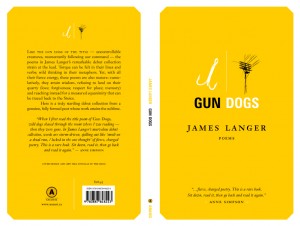
The Lampert Prize for best first book is always interesting, the shortlist providing a group of writers many of whom you haven’t heard of yet. James Langer won the award for Gun Dogs. I realize that I am biased, but I think this is a book we’ll all be reading years from now.
Karen Solie won the The Pat Lowther Memorial Award for Pigeon, obviously a very fine book. It’s been showered with awards. Take a look and see.
Ross Leckie
Editor
I was asked to participate on a panel on ekphrasis, poetry about the visual arts, organized by Ruth Roach Pierson. She read an insightful paper that laid out the historical background of ekphrasis. John Reibetanz was on the panel, and his paper contained all the delightful wit we’ve come to expect from him. I didn’t give a paper exactly. Instead I listed eight ways of thinking about ekphrasis and talked about how they might be approached if you were writing an ekphrastic poem. The panel was chaired by Anita Lahey, who is editing an issue of ARC on ekphrasis.
There was an excellent panel on experimental poetry. Sina Queyras was captivating in talking about how politics are shaped in the open field of her work. She also gave an exceptional reading from Expressway at the Bar Italia, as part of the opening night celebrations.
Anne Simpson gave the Szumagalski lecture this year. I won’t recapitulate it here. Watch for it on The League's website in the section on The Anne Szumagalski Lectures Series. It’s not up yet, but if you want to look at what Tim Lilburn or Anne Carson have given in the past, the full texts are available.
The Lampert Prize for best first book is always interesting, the shortlist providing a group of writers many of whom you haven’t heard of yet. James Langer won the award for Gun Dogs. I realize that I am biased, but I think this is a book we’ll all be reading years from now.
Karen Solie won the The Pat Lowther Memorial Award for Pigeon, obviously a very fine book. It’s been showered with awards. Take a look and see.
Ross Leckie
Editor
Tuesday, July 13, 2010
Congratulations to James Langer!
Thursday, July 8, 2010
The Fiddlehead Wins National Magazine Award
The National Magazine Awards winners have been announced and The Fiddlehead is pleased to say all five of its nominees did well.
In the Fiction category Steven Heighton's story, "Shared Room on Union" won gold. And "Back to Disney" by Jeff Park and "The Spanish Hour" by J. M. Villaverde were honourable mentions. All three stories were published in The Fiddlehead 240 (Summer 2009).
In the Poetry category honourable mentions were given to Anne Compton’s three poems, "Stepping Off," "It starts with names," and "We waited" from The Fiddlehead 239 (Spring 2009) and to Vanessa Moeller’s poetry sequence,"Abandoned Postcards Found in Hotel Room 464," from The Fiddlehead 241 (Autumn 2009).
In the Fiction category Steven Heighton's story, "Shared Room on Union" won gold. And "Back to Disney" by Jeff Park and "The Spanish Hour" by J. M. Villaverde were honourable mentions. All three stories were published in The Fiddlehead 240 (Summer 2009).
In the Poetry category honourable mentions were given to Anne Compton’s three poems, "Stepping Off," "It starts with names," and "We waited" from The Fiddlehead 239 (Spring 2009) and to Vanessa Moeller’s poetry sequence,"Abandoned Postcards Found in Hotel Room 464," from The Fiddlehead 241 (Autumn 2009).
Congratulations to everyone!
 |  |  |
Subscribe to:
Posts (Atom)