Showing posts with label Reflections on Writing. Show all posts

Monday, June 11, 2012

Taking Leave: Mindful Self-Reproach & the Repudiation of Cultural Gender Expectations in Danielle Deveraux’s “Playthings”

The accolades for “Cardiogram”, the eponymous poem of Danielle Devereaux’s 2011 Baseline Press debut short collection have been many. From "Cardiogram"'s initial publication in The Fiddlehead 244 and subsequent inclusion in The Best Canadian Poetry in English 2011, to the attention it has received from reviewers at Salty Ink, Literatured.com, and elsewhere, it’s abundantly clear that this little poem has legs. It’s no accident that the lion’s share of critical praise of the collection has landed at this poem's feet, as it’s poignant, darkly comic, handsomely crafted, and, with apologies to “Mainland Man,” the consensus tour de force of the collection.

That said, much like the forlorn, love-sick heart Devereaux expertly conflates with a hopelessly selfish and perpetually needy pre-schooler within its lines, “Cardiogram” demands so much of our attention that we might well be forgiven for overlooking and failing to celebrate the many other truly memorable poems included in the chapbook.  It’s true, of course, that a handful of these have found homes in some of the more eminent Canadian literary journals, and in that respect, managed to find an audience on their own merit, but the one that most interests me as a reviewer, and that, to my knowledge, has generated the least amount of critical interest, is “Playthings,” the longest and quite possibly the most ambitious and demanding poem in the collection.

What we’re struck by first in this difficult, beguiling, and wilfully slippery poem is the cautionary and authoritative tone of the narrative voice:

Spend too much time playing, dreaming your
little-girl dreams with hair clips, fake
lipstick, mirror-mirror, the [b]right pink glitter
wand and bam! Your legs will become so thin,

so long, they’ll barely support the weight
of your new breasts ... 

That this disapproving and even patronizing admonition should be followed immediately by “but never mind. Think of the shoes:/open-toed peach stilettos, sweet/little white pumps with pink at the heel and toe” establishes an overriding dichotomous (and perhaps even trichotomous) imperative within the poem that continues to play out (pun intended) for the duration.

Now, it may well be that the latter excerpt is meant to be considered as an extension of the opening reprimand, as the narrator’s offhand remark some four lines later “[s]o what if your mother’s a German/porn doll, you’re better than her,” can certainly be read as an ironic means of furthering the initial condemnation. But what we need to consider is to whom the poem is being addressed. While it can be read as outwardly directed (i.e., a warning to impressionable elementary school-girls), or as an address to the doll itself and all that entails, it should primarily be considered an interior monologue wherein a reckoning takes place between mindful self-reproach and the narrator’s more primal impulses towards the mesmerizing manufactured iconography of perceived female beauty and glamour within our culture.

The ironic tone throughout creates the distance and separation necessary to facilitate believable disdain, but Devereaux appears to intentionally complicate the poem’s chastising directive by indulging in an almost fetishistic labelling celebration of all the accoutrements of the Barbie brand by using precisely the kind of descriptive language developed by predatory marketing executives:

The Peaches and Cream ball gown, the Day-to-Night
Hot-pink business suit and your fave, the prom queen
Pretty in pink, hand over the tiara, dream dress.

If nothing else, this predilection indicates an immersive knowledge of the product line, and one, we gather, that is no longer wanted or welcome. Ultimately, the poem provides a forum in which the reader bears witness to an extrication or exorcism of sorts where the literally impossible glamour and beauty fallacy, like a malignant growth, is excised once and for all from the narrator’s self concept.

Behind all the saccharine descriptive language and tongue-in-cheek surface-level endorsements a righteously angry voice cleverly manages to express the hurt and disappointment of having been cheated, lied to, and manipulated. “You’re gutted,” the speaker remarks in the middle of the poem, and while this statement literally addresses the doll, it’s almost certainly meant to be read as self-reflexive. The stanza continues:

                         Cinderella and Prince Charming,
Snow White and that other Prince Charming,
Beauty and the Beast, Ken and you – the blonde

hair, the big boobs, the hot pink box – ruined.

And with this the dénouement begins. Having already catalogued the ludicrous presumptions of impossibly glamorous career outfits, Devereaux’s speaker takes aim at the ideal of unattainable female beauty the doll represents, and cleverly utilises the euphemistic “hot pink box” to devastating effect.

As “Playthings” builds towards its startling final image, it’s no accident of chance that “the sweet little white pumps with pink/at the heel and toe” should make a second appearance, only this time, the narrator remarks “about those shoes, they never did fit.” Aside from cleverly extending the argument of the poem and resonating perfectly with its already established imperative, this almost deadpan statement, it seems to me, both enters and furthers a conversation established almost exactly a half century ago by a poet of considerable renown who also recognized the figurative possibilities of constrictive footwear as a means to express the emotional and psychological damage done as a result of paternalistic subjugation.

From the "hoarding of hurt" we encounter in “Conservation Policies” and the “Lady Lazarus”- like the devouring of a “lover’s wedding band” in “Quelle Affair”, to the “tongue [that] may want/to slide along the smooth hard/edge of a belt buckle” in “How to be a Spinster, circa 2010” and its echoes of “[e]very woman adores a Fascist/the boot in the face” from “Daddy,” Sylvia Plath’s influence is palpable throughout Cardiogram. But to suggest that Devereaux’s approach is derivative would be to mistake the matter entirely, as she never steals, and borrows only as a means to complicate, celebrate, and newly assert the spirit of female self-empowerment and wilful resistance that’s so inherent to the poetics of her predecessor.

Danielle Devereaux
“Playthings” closes with the “pink corvette,” Barbie’s most longed for accessory, “overturned in a ditch,” the doll itself, “naked from the waist down, still smiling,” and the reader can’t help but marvel in amazement at the genius with which Devereaux delivers her knockout blow. The Plath of “Elektra on Azalea Path” “[s]mall as a doll in [her] dress of innocence” who watches “the ersatz petals drip ... red” beside her father’s grave, the same father who bit her “pretty red heart in two” in “Daddy”, would surely applaud the frank and unrelenting manner in which the oppressive and harmful force in this poem is identified, exposed, and ultimately repudiated. So should we. Quietly irreverent, technically astute, and emotionally fearless, Danielle Devereaux is sure to become and remain a force in Canadian poetry for years to come. I, for one, am very much looking forward to the publication of her long-awaited book-length manuscript in progress. If Cardiogram is any indication, it’s sure to make a splash.

Phillip Crymble
Poetry Co-editor, The Fiddlehead

Tuesday, April 3, 2012

Rebels with a Cause: France’s 13e Note Editions


In 1934, Obelisk Press of Paris published Henry Miller’s landmark novel Tropic of Cancer. Banned in the United States, Grove Press’ 1961 American edition was subsequently tried on charges of obscenity and pornography, eventually and painstakingly resulting in acquittal three years later in 1964. It took 27 years for Miller, an American, to get published in his native country, and when he finally did, it was still under the clouds of institutional rejection and slander. The point is that before Miller garnered mainstream acceptance, someone was willing to take a chance on him and his work. Economics and practicality aside, it is increasingly rare to find presses willing and able (realistically) to go with their gut — to publish what truly excites them as a matter of principle and, perhaps this is the Romantic in me, obligation.
   This sense of duty and passion is where my interest in the French publishers 13e Note Editions http://www.13enote.com stems from. The literary world has recently lost two giants who championed the alternative and controversial: George Whitman, long time owner of Paris’ Shakespeare and Company bookstore, and Barney Rosset, the Grove Press publisher who took a chance on Miller. As fervent supporters of literature senselessly repressed and marginalized, Whitman and Rosset laid the groundwork upon which presses such as 13e Note importantly still stand. The names Dan Fante, Mark SaFranko, Tony O’Neill, J.R. Helton, and Matthew Firth (among others) might not be familiar to those reading this blog. The aforementioned names have done everything from toil in obscurity to achieve measured success in North America with HarperCollins (O’Neill, Fante, SaFranko — all after starting out with micro presses) and Anvil Press (Firth — who resides in Ottawa). Starting with their interest in Fante, 13e Note has been praised for their translations of North American writers into French, and France, as astute a literary nation as there is, has responded in kind by paying attention to and buying books by authors who are unfortunately often overlooked domestically.
   13e Note founder Eric Vieljeux was kind enough to take time out of his busy schedule for an interview. What follows is a short conversation to help introduce readers of The Fiddlehead to 13e Note’s ethos and why, as a foreign press, they support and promote American and Canadian writers. I encourage readers to browse 13e Note’s website and catalogue where you can also get to know the writers they so fervently believe in. All I will say in closing is that as staff, readers, and supporters of an internationally renowned literary magazine based in a bilingual province, it is our obligation and to our benefit to make and uphold trans-Atlantic connections, and to recognize the excellent work of our peers in the global literary community.

Zach Alapi
Editorial Assistant 

ZA:What inspired you to start 13e Note Editions? Can you talk about the Press’ ethos?

13e Note: Some years ago, driving around LA with a friend, we passed by the mansion of Michael Crichton, and my friend said: “the one who really deserves this house is Dan Fante.” I have read Dan since his first book was published in France and then bought and read all his work... I truly love his writing.
   When I had the money to lose in a publishing venture, I thought I would only publish Dan Fante, as he had not been published in France for the past 10 years and I really believed he deserved to shine in all bookstores. So I went to see him and told him I had never published a single sheet of paper in my life but asked if he would he let me do his last book (and commit to do his other major works). That was March 2008; he said yes.
   Then Sandrine joined me and I quickly understood that to succeed you need top-notch distribution-diffusion, and to get that you need a real editorial project, not one writer and one book. But the fruit was ripe, in my mind, and immediately paid dividends with interest in Mark Safranko, Tommy Trantino, Tony O'Neill, Barry Gifford etc.... We had the project(s) and seduced FLAMMARION as a distributor. Then Patrice joined, and Dan’s book came out in April 2009.

   Yes, we have an ethos and principles, though they are obvious:
  • stay away from dickheads and make this venture as pleasurable as possible;
  • present unpublished writers (though not exclusively) to French readers;
  • only publish what we love;
  • make as few concessions along the editorial line as possible (no detective stories/genre fiction unless they are realistic, etc.);
  • have fun doing it.
ZA: Of particular interest to readers of The Fiddlehead will be the success you’ve had publishing North American writers in French translation. What is the process like in selecting an English manuscript for publication in France?

13e Note: The success is relative.... Of course, when you are unpublished in your own country, or published by a small Press and hardly distributed, selling 3000 copies of your book in France brings some notoriety success.
   But foreign literature is very costly and so far, out of the 37 titles we’ve published, none has had what you may call “financial success,” which is key to remain in the game.
   So yes, we have [had success] and we are gaining notoriety/success for publishing so many of these writers who have never been translated into French. We also have a strong graphical ID and, for the first time, decent PR.

ZA: It seems that 13e Note’s literary and historical predecessors are ones that have attained success writing controversially from the margins of society (before widespread recognition); writers such as Jack Kerouac, John Fante, Henry Miller, Charles Bukowski, Hubert Selby Jr. (and others) come to mind. How does 13e Note both adhere to and transcend these important influences? How does this historical consciousness inform what you do as a contemporary press?

13e Note: Our selection is spontaneous; we know what we’re looking for in a novel, or short stories, or prose poetry, and we never cease searching for it — on our own and sometimes through recommendations from other writers. This is really mine and Patrice’s turf; all doors remain open, and if we could, we would publish classic writers like Edward Lewis Wallant or Thornton Wilder, etc. Also, remember that nobody waited for us to publish great noir writers, so we have to “fish” every day, and we take risks... certainly more than other publishers.
   Of course, we acknowledge writers and works that have inspired those we publish today. But, take Jack Kerouac, for example... as publishers, we are more interested in the writings of his daughter [Jan Kerouac] than his own works that have already been extensively commented on and distributed.


ZA: In 2011, you released an impressive anthology, Le Livre des fêlures, 31 histoires cousues de fil noir, comprised mostly of translated stories. How/why did this come about, and what do you feel links the writers you selected for this anthology?

13e Note: In 2010, we released Le Livre des fêlures, a massive anthology for our modest press, as we worked on/published it while simultaneously working on our regular program. We were reading many exciting pieces, some by writers published in France and some by unpublished authors that we thought we ought to do something with. Realistically, we cannot publish every project that excites us, so the anthology sort of promoted and publicized the literary genre we love and promote. This book won the Prix De La Nuit Du Livre thanks to the sweat and talent of Patrice Carrer.
   In putting together the anthology, we had: 31 cool and lively biographies with author pictures, 31 contracts with money sent in envelopes to rehab centers, agents, and independent writers, dozens of translators and 31 quality stories, all assembled spontaneously and organized [by genre—Néo- Beat, Méta-Réalisme, Off-Noir, Inside Out] by Patrice to help guide the reader. We will re-issue it in our new Pocket-Pulse collection.

ZA: As The Fiddlehead is a Canadian-based magazine, I want to talk a bit about Matthew Firth, who you are currently working with. Much of Matt’s fiction importantly deals with Canadian cities and the gritty experiences of their inhabitants. What drew you to his fiction, and what qualities in his writing make you feel his material will translate well to French and European markets?

13e Note: First, Matthew Firth is also a publisher and we love the same stuff. I do not think it is obvious that Matt writes about Canadian cities and their inhabitants; there aren’t that many hints in his writing. But obviously he lives there, so it works its way in. We love his fiction because it is without concession and [it] honestly depicts human nature. It is honest and sometimes brutal, and always has a sense of humour. Matt, like Dan Fante, does not hesitate to put his family jewels on the table and be vulnerable. We love that. I have never asked myself whether his [Matt’s] work would or wouldn’t translate well to the French market before deciding to publish him.

ZA
: Lastly, does 13e Note have plans to expand its market directly to North America? With Francophone populations in Quebec and New Brunswick, do you see potential/value in fostering a sort of “global” literary community?

13e Note: We have plans to expand into the U.S. and Canadian markets as soon as our French venture can somehow balance/sustain itself. The future, unless we find a partner (pronto), is very bleak, as sales, our main source of financing, are just not happening. Unlike others, we have no country rights to negotiate, movie deals either never happen or come about once in a blue moon… our sales income is paid with a 4 month delay, we have no back catalogue to sustain sales, and, frankly, it is incredibly difficult to publish an unknown writer and get him media attention. Only passion and enthusiasm keep us going… but for how long?
   Lastly, my dear Zach, we are four at 13e Note Editions, and whatever has been achieved so far would have been impossible without the talent, dedication, and shared passion of Sandrine, Adeline, and Patrice. They carry this Press on a daily basis, and I am so grateful they trusted me from day one.


Wednesday, March 14, 2012

Show Me the Way to Go Home: Place & Belonging in Shoshanna Wingate’s Homing Instinct


This past October I had the opportunity to both attend and participate in the 8th annual Poetry Weekend on the UNB campus here in Fredericton. The three day event is a veritable Newport festival of poetry performance that provides a collegial atmosphere for established and emerging writers alike to read selections of their work to an enthusiastic public.

Shoshanna Wingate, one of the weekend’s standouts, captivated the audience with powerful and emotionally sincere poems read from her recently published short collection Homing Instinct.

Content aside, Homing Instinct is a handsome, limited edition hand-sewn chapbook meticulously assembled using specifically selected archival papers and print pigments, making it a work of art in its own right, and a delight to handle. Congratulations to Frog Hollow Press for constructing yet another distinctive bibliophile edition.

Home and all of its accoutrements, conventions, and cultural imperatives are made accountable in Wingate’s collection as it moves inexorably towards the final reckoning we encounter in the closing poem. “Neighbours” and “The Cotton Mill” come early in the book, and as companion pieces, work to both establish and entrench the prevailing thematic locus.

In “Neighbours,” tensions between adult realities and the child speaker’s narration of her perceived experience are subtly communicated, as in the offhand remark “my papa says it’s quaint and cheap,” describing why they are ostensibly squatting in an Appalachian backwater. The use of statement also works as an effective counterpoint to the bucolic scene, as when the speaker surprises us by suddenly entering the narrative in remarking “no one knows people live down here,” thus revealing her agency and perspective in the world of the poem. The children “drape the willows around [their] necks / like scarves, serve moss tea to frogs / on stumps that serve as parlour sets, / and fan [themselves] with ferns like queens” as the poem closes, and despite what the reader now knows of actualities, the notion of home as filtered through the speaker is as pure, satisfying, and real as we will encounter in these pages.

Wingate continues the childhood Appalachian narrative in “The Cotton Mill,” though the voice of the poem seems more worldly and knowing. Gone is the fanciful, rustic paradise of the previous poem, and in its place we find a once functioning cotton mill — the blind monster of the poem — with all its windows bricked in, eyelessly glowering over the landscape like a fallen Oedipus. The choral device of repeating the first two lines — “[w]e raced our bikes around its glass-strewn lot, / along abandoned railroad tracks down river” — in the middle of the poem, aside from acting as a temporal reset and referential tie to classical tragic texts, is yet another means of emphasizing the shift in point-of-view. The children continue to play in this environment, but its realities are very much foregrounded, and instead of fanciful, imaginative games of make-believe, they “[pitch] rocks at the windowless windows” and have “all the injuries / of youth to unleash: schoolyard fights, our fathers’ / worthless jobs…[,] our lack / of anything better to do.” That the poem can be read as a post-industrial vision of America, it’s economic and accompanying cultural infrastructure in ruins, is likely no accident, nor is the portentous arrival of “folks even poorer than us” brought, ironically, by the “Holy Roller Church” — an apparent allusion to outsourcing, and a not so veiled condemnation of missionary interference.

Mid-century cult crime novelist Jim Thompson has one of his characters remark of homicidal anti-hero Lou Ford in The Killer Inside Me that “a weed is a plant out of place,” and I couldn’t help but be reminded of the wisdom in those words while considering the closing poem in Homing Instinct, “The City Dwellers.” Weeds are featured prominently, and their invasive, almost malevolent agency is masterfully presented and complicated throughout. “Their roots,” we’re told, are “as thick as wrists, had gnarled split tails, / white flesh… as long as twinned ermines.” Ominous, certainly, but in choosing ermines as a metaphor, Wingate intimates that the weeds, in some capacity, can be read as regal or noble, a characteristic compounded by their blooming buds, described as “round like Queen Anne’s lace.”

It’s this notion of belonging and the place of competing identities within the speaker relative to established definitions of home that Wingate wrestles with in “The City Dwellers.” As a “domesticated” space, home is rendered untenable here — something that can’t be, or refuses to be, fashioned to the speaker’s will. Having settled in the rural environment of the poem some years ago after having previously lived an urban and presumably itinerant lifestyle, she struggles to impose the learned sense of order she believes is necessary to realizing her culturally prescribed idea of home. The fence built by a neighbour, in all likelihood to block the untidy, unconventional space the narrator exhaustively labours to tame, is met with relief, as it brings “some outline of order.”

A similar feeling of perceived contentment or groundedness is communicated when Wingate writes off of her subject by interpolating a back-story episode wherein her speaker is put at peace by watching a former neighbour exercise his trained pigeons on the roof of an urban walk-up. But it’s precisely this imposed sense of constraint that is ultimately undermined as the poem moves forward: “Something there is that doesn’t love a wall / That wants it down.” Frost’s maxim from “Mending Wall” couldn’t be more appropriate to Wingate’s purposes in “The City Dwellers,” as the order of the fence, and the compliance of the trained pigeons, although outwardly celebrated as efforts at containment, are ultimately indicted as absurd artificialities. The spanworms that decimate the speaker’s garden act as a clever thematic counterpoint to the trained pigeons we encounter in the middle of the poem. Emerging from their pupas, they soar over the “pockmarked garden, without / another notice, not for its destruction / or their battered homes, cared nothing for what/they left behind, nor dwelled on what survived.”

The message, then, both in “The City Dwellers” and the collection at large, may well be that we need to reclassify our notions of what home is and means. It seems much less a physical place, and more, simply, where we find ourselves. Wherever we are is merely a vehicle we put to use in the interest of perpetually moving forward. In Homing Instinct, Shoshanna Wingate gracefully communicates a timeless and difficult truth. It’s in the journey that home is found, not in some perceived final destination.

Phillip Crymble
Editorial Board

Wednesday, February 29, 2012

The Kinaesthetics of Poetry: On Anne Carson and the Dancer I Never Was

The gangly-legged childhood version of me wanted to be a figure skater. My parents, regrettably, acquiesced and, after getting me properly outfitted in a pair of Don Jacksons and some sparkles, sent me tottering off to the Sackville Arena. I spent hours rehearsing camel spins, Salchows, and Ina Bauers, went through endless pairs of flesh-coloured tights, but, in the end, I was always flutzing my Lutzes and gradually came to accept that I would never be an Olympian (let's face it, I was already older than Tara Lipinski. Also, I had better things to do after school than endure below-zero temperatures in the few months of t-shirt weather we got (and, those sequined dresses aren't cheap, you guys). So I settled for playing my Michelle Kwan Figure Skating CD-Rom game on my parents' desktop and reading all the books in the Silver Blades series. (I'm not gonna lie. I still own Rumors at the Rink.)

In high school, my closest friends were more forward-thinking and had chosen a much more useful hobby--dance. They had shows in downtown lofts; they performed at pep rallies; they were called on for choreography when the drama club put on musicals; they weren't awkward at late-night school functions. I resented my parents for not squashing my dream to learn what seemed, to my hyperbolical high school self, an utterly untranslatable skill. (They could've at least warned me. Or given me some pointe shoes for Christmas.) Too embarrassed to join the young'uns in beginner classes, I decided to love dance from afar.

And so here I am today, considering myself to be (hopefully) a bit less gangly and hyperbolical, even more intrigued by the translatability of dance-- specifically, the relationship of dance to poetry. Lately I have been interested in poets who push closer to the fine line between music and poetry (Dennis Lee's Body Music, Robert Bringhurst's spoken scores for multiple voices, Jan Zwicky's Forge, to name a few). Most recently, I've become obsessed with Anne Carson's collaborations with Merce Cunningham dancers.  In their first project together, The Possessive Used as Drink (Me): A lecture on pronouns in the form of 15 sonnets, each poem is danced as well as read aloud. Watching this was a completely different experience than any dance I had seen before although I couldn't exactly describe why. Robert Bringhurst has said that polyphonic poems contain “two or more interrelated but independent statements” and the combination “exceeds the sum of its parts” (“Singing with the Frogs”). In The Possessive Used as Drink (Me), though not exactly an example of polyphony, there are two independent, interrelated statements although they are not both vocal--one does not seem to dominate the other; one does not seem to be set to the other. The dancers' expressions are statements that, combined with the words being read aloud, “exceed the sum of their parts,” and the effect of the multiple narratives happening simultaneously appeals to multiple senses with new possibilities for imagery.


“Drop't Sonnet” is read without much expression or variance in volume. The dancers' faces are cut off as well, so we turn to the words themselves and the movement to find expression.  At the end, the faceless dancer in the foreground uses a foot to eclipse the face of the dancer in the background. Simultaneously, Carson speaks of that loss of differentiation: “when a language drops a distinction… as for example English has modified the second person singular”   and “I confess not til I met you did I begin to feel this change as a loss.” It was at this final movement that I realized poetry is not standing in for music here. Contemporary dance is usually thought of in combination with music, but dance combined with the spoken invites you to hear the dance in a different way. It is not like a dance to music. I have been trying to discover what this difference is, what it is that seems to change the to to with, and while it might not fit the definition of musical or literary polyphony, these poems seem to have a similar effect: the combination of poetry and dance creates a kind of music, a resonance, here.

More recently, Carson has continued to collaborate with Merce Cunningham dancers on numerous other projects. Nox, the multi-voiced epitaph for her brother that scrapbooks elegy, translation, lexicography, letters, and anecdotes is rife with multiplicity even before the dance is added.


In this video, the moment when Carson's intensely personal words, spoken without emotion, juxtapose with the emotive body language of the two dancers, the gravity of the loss is communicated so clearly. Dennis Lee says poetry is “like hearing a constantly changing tremor with your body: a play of movement and stress, torsion and flex- as with the kinaesthetic perception of the muscles… More and more I sense this energy as presence both outside and inside myself, teeming towards words” (Body Music 3-4). In these collaborations, kinaesthetic perception of poetry is experienced in a whole new way. The final moment when the dancer balances, shaking, muscles taut, on the windowsill as the blinds come down in front of him, trapping him between inside and outside, is a beautiful image to not only illustrate the restrained grief of the piece, but also to feel it, bodily, even as Carson's voice continues in the darkness.

Dennis Lee also speaks of poetry in dance terminology: “the way the poem moves in time--its pace and gait and proportions. A poem can unfold with the shapely aplomb of a gavotte, or meander, or wove with a quicksilver stutter and glide” (Body Music 197). This is no accident. The two are often connected figuratively. In these videos, where the connection becomes literal, the dancers are not so much dancing to the poems (with words substituting for music), but as a part of them-- contributing their own voice, speaking simultaneously, even polyphonically, and creating new resonance.

Chantelle Rideout
Editorial Assistant 

Wednesday, January 25, 2012

10 Rules for Submitting

If you missed the deadline for The Fiddlehead’s 21st Annual Literary Contest, fret not! The Fiddlehead accepts submissions year-round so if immortalization on the page is what you seek, you’re in luck. Fire up the printer, break out those stamps, and adorn that cover letter with your best John Hancock. But if this humble author may be so bold as to momentarily delay your merry skip to the post office, here are a few things to consider to ensure your submission has been properly outfitted.

Taking a page out of the Globe and Mail’s column on “10 rules for writing” (who took a page out of the Guardian’s “Rules for writers” series, who took a page out of Elmore Leonard’s 10 Rules of Writing . . . I feel like I’m following the yellow-brick road . . . ), here are ten suggestions on submitting. Sending your prized brainchildren to far-off publications may seem daunting, so hopefully this list will ease some of that confusion and anxiety.

1. If submitting prose or multi-paged poems, paginate your submission. Accidents do happen (a gust of wind! a toppling stack!) which make page numbers crucial in piecing your submission back together.

2. Use a legible font. As tempting as it may be to type in jokerman, resist the urge. Times New Roman and Arial are indeed old-school, but the classics never go out of style.

3. Print on clean, white-washed paper. You want your submission to stand out, but using neon-green cardstock may be taking it a little too far.

4. Use the appropriate margin size and line spacing as specified by each publication. Preferences vary from journal to journal, so taking the time to adhere to their formatting guidelines will put a smile on the editor’s face before they’ve even read your opening line.

5. Make sure you’ve included your contact information in the appropriate places. Some journals require the author’s name and address on every page while others prefer to not have any identifying markers at all. Correctly placing your contact information may save your submission from ending up in the recycle bin.


6. Check to see how the publication prefers the submission to be bundled. Some prefer staples; others, paperclips; others still, nothing at all. Each journal has a tried-and-true method for handling submissions, to which your blasphemous staple or paper clip may be the disastrous wrench.

7. Include a cover letter. You would do the same if sending off your resumé, so why should your story or poem receive any lesser treatment?

8. Always always always include a SASE. Or at the very least, an email address. It’s rather difficult for an editor to send you that coveted “yes!” with no means of getting in contact.

9. Affix proper postage to your SASE. If you’d like your manuscript returned, make sure you’ve included enough stamps to do so. Most journals survive on grants, subscriptions and the kindness of their readers, which sadly doesn’t leave much wiggle room in the annual budget.

10. You must, indeed, skip on your way to mailing your submission. Through a mystical process that I’ve been sworn to never reveal, skipping endows your submission with a quality akin to being showered in fairy dust. Hah! Not really. But in all seriousness, relax and take your time in putting your submission together. Submissions that are a joy to compose are almost invariably a joy to receive.

While these rules cannot guarantee eventual publication, keeping these suggestions in mind will aid in your submission being efficiently processed and properly dispatched to the correct editorial committee, rather than being either rejected for not following the guidelines or left to languish until someone can figure out where it  should go. This in turn means a shorter response time to the actual submission. And as any writer can attest to, waiting four months as opposed to nine months (or longer) for a cordial “no” wins first runner-up to being accepted for publication.

Of course, these suggestions pertain mainly to hard-copy submissions. Online and e-mail submissions are a whole other can of worms (perhaps someone will take a page out of my book and author those lists?). But I’ve delayed you long enough. Send us your stories and poems! We’re eagerly waiting to read your work.

Christina Cooke
Editorial Assistant

Tuesday, January 3, 2012

Celebrating Young Literary Ladies!

I listen to CBC radio quite a bit, mostly because I can’t pay for cable, and I have run through all my DVDs, namely, a four-season box set of A Haunting and some bootlegged Harry Potters with burnt-in Greek subtitles. The CBC, as I am sure you know, has some terrific programmes and personalities (Eleanor Wachtel, especially). There are, too, these somewhat bizarre features, interviews with pseudo-scientist types whose main goal, it seems, is to shame the Younger Generation. What, with our Internet and Hot Pockets, we’re little more than lazy, apathetic, unhealthy, unhygienic, mouth-breathing menaces to society. The Older Generation, you see, does not think much of us. Last month on the CBC, a man expressed fear that his grandchildren would not actually be able to use their legs. I think he was being hyperbolical, but it is so hard to tell when we all know how the muscles of Young People Everywhere have atrophied from years of neglect. Also, we do not read, ever. The Older Generation harps on this a lot. Young People today! Can’t live with ‘em, can barely understand what they’re saying behind the Harvey’s counter. Another thing: we have poor elocution (because, you guessed it, we do not read).


Of special interest to the Older Generation is the Young Lady Problem. To give a poor illustration: have a look at articles about Twilight fans. Words that crop up repeatedly: female, hysterical, shrieking, hordes. Some of the more deft wordsmiths use all of these words together in a sentence. This, basically, is what the Older Generation seems to think of young women. Don’t believe me? A certain national magazine ran a cover-page headline in 2010, “Inside the Dangerously Empty Lives of Teenage Girls.” In it, Dr. LeonardSax (male), expounds upon the fragile, shallow psyche of the young woman (female), whose life revolves around Facebook and impressing her peers. You know, that age-old adage – young women: they sure do hate each other! Did I mention that they don’t read books? This is only one example of a lot of the hand-wringing that goes on. The Older Generation is just so concerned about the young, female intellect. So fragile! But I won’t belabour the point (probably). What I will say is: all the young women I know are intelligent, involved, creative, excellent human beings. They’re writing, making movies, attending academic conferences, starting businesses, small presses, lobbying for social and political causes, working real jobs, and, yeah, kind of leading fulfilling lives. So, in celebration of these young women, here is a (very short) list of young Canadian literary ladies (whom I admire) and their work. 

Gillian Sze, Fish Bones
El Jones, Halifax-based spoken-word artist
Leigh Kotsilidis, Hypotheticals
Linda Besner, The Id Kid
Sachiko Murakami, The Invisibility Exhibit
Esi Edugyan, Half Blood Blues
Johanna Skibsrud, The Sentimentalists

And finally, recent UNB Alums Rebecca Geleyn and Allison LaSorda, who have three poems apiece in the Fall 2011 issue of the Malahat Review


Sarah Bernstein
Editorial Assistant

Thursday, December 8, 2011

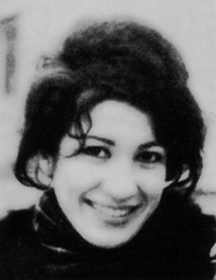
Reading Forugh Farrokhzad in December

Iman bivarim beh aghaz fasle sard —
“Let us believe in the beginning of the cold season”

As the weather grows colder and academic deadlines collide with the hectic holiday season, the urge to procrastinate mounts. At some point I eventually give in and spend a few of these long, gray afternoons with the poetry of Forugh Farrokhzad. Her intricate manoeuvring of abstraction, visceral imagery and dense metaphor remind me why, like her, “I respect poetry in the very same way religious people respect religion” (Collected Works).

I first came across the Iranian poet and filmmaker by chance at the annual University Women’s book sale in Moncton, NB when I was ten years old. Despite my general lack of acquaintance with the adult world and its gender politics, her work possessed and moved me — something of the deeply nuanced and complicated subject matter conveyed through deceptively simple language entranced me. The book Tavallodi digar or Another Birth was lost in a move and my parents were unable to locate another English translation.

Fourteen years later, an Iranian friend re-introduced me to Farrokhzad. He gave me a bilingual Farsi/English collection and loaned me recordings of her poetry which, despite the language barrier and sometimes distracting musical interludes, greatly contextualized her lyrical phrasing.  This eloquent performativity that expounded her Modernist free-verse and feminism deeply offended the conservative male Iranian poets of her time. Farrokhzad was the first to detail the difficulties of life for Iranian women and she re-wrote stereotypes of modest, subservient women as caged, passionate, independent, and sexual individuals. She also wrote about her lovers in detail and had no issue juxtaposing the erotic with Islamic tradition (“Conquest of the Garden” & “The Wind-Up Doll”).

As the citizens of Iran and other Middle Eastern countries strive in hopes of achieving leadership that more accurately reflects contemporary visions of its peoples’, I cannot help but think of Forugh Farrokhzad whose nature seemed to be innately connected with a desire for equal human rights. In her poem, “Let us believe in the beginning of the cold season”, Farrokhzad re-examines her life’s struggles against prominent ideology. The poem’s tone is largely pessimistic: “And this is I/ a woman alone/ at the threshold of a cold season/ at the beginning of understanding/ the polluted existence of the earth...and the incapacity of these concrete hands.” Yet it claims believing in “the beginning of a cold season” as central to the metaphor renewal, of taking up the struggle once again: “next year when spring/ sleeps with the sky beyond the window/ and her body exudes/ green shoots of light,/ branches will blossom./ Let us believe in the beginning of the cold season.”

Raised in a household that strove to maintain a conventional appearance, she was married at 17 and divorced at 19. Custody of their son was awarded to her ex-husband. While composing and performing poetry has been and continues to be a vibrant and thriving art form in the Middle East, as a divorcée writing about feminist concerns and her sexuality, she gained much disapproval. When living abroad she met her long-term lover Ebrahim Golestan and after their return to Iran she filmed a documentary called The House is Black that explored the inhumane treatment of lepers. She died in a car accident in 1967, at the age of 32.

In 2010, Forugh Farrokhzad was excluded from an Iranian published compendium of poets despite her continuing international and Iranian popularity. Most critics believed this was a political decision as her poetry is still considered inflammatory (PayvandIran News).  However, Farrokhzad’s popularity and politics took a stance the 1999 film Bad ma ra khaha bord or The Wind Will Carry Us by Iranian filmmaker Abbas Kiarostami, the title an abbreviation of one of Farrokhzad’s most popular poems. In one scene, the protagonist (or antagonist, depending on how he feels that day) recites a portion of “The Window” and “The Wind Will Carry Us Away” to a young woman as a way of encouraging her to find ways of meeting the world outside her village.

The most recent and contemporary translations of Farrokhzad’s work have been collected by Sholeh Wolpe who has chosen what she considers to be Forugh’s best or most provocative poems. Wolpe’s translations are very fine but in some instances I feel she has stepped too far away from Farrokhzad’s traditional lyricism. This edition was published under the title Sin by the University of Arkansas Press in 2007. A Lonely Woman: Forugh Farrokhzad and Her Poetry by Michael C. Hillman, is a text that critically examines her life and literary career; excellent translations of her better known poems are included. Internet book dealers can usually scrounge the odd bilingual copy of Asir (Captive), Divar (The Wall) or Tavallodi digar (Another Birth).

Kayla Geitzler
Editorial Assistant

Thursday, November 24, 2011

Grumpy Old Men (On Richler and Sendak)

At my Jewish high school in Montreal, Mordecai Richler, of course, was a bit of a hero. Whether or not he liked it, and even though he relentlessly lampooned the Jewish community, he was still one of ours. February at our school was public speaking month. So, every February, the teachers compiled and distributed a list of quotations to all of us groaning, gawky teenagers – possible speech topics from which we were to choose. Each year, not unexpectedly, writing from Richler’s books was excavated and placed completely out of context on this public speaking list. Richler’s “memorable quotes” could be read alongside pieces of wisdom from the Dalai Lama and Nelson Mandela.
 
A recurring favourite was a piece of dialogue lifted from a scene in Duddy Kravitz. Drunk Aunt Ida tells Duddy: “The human personality is like an iceberg. Nine tenths of it remains submerged.” Of course, our teachers chose this quote because it’s something all teenagers feel: misunderstood.  So, predictably, each year, earnest speeches of the you-don’t-know-me variety proliferated. We applauded our classmates and felt better about ourselves.

We had no idea where these words came from, so neatly pared down and packaged as generic “inspirational quote.” We didn’t know, but our teachers did. They knew that Duddy, by way of response, thought, Ver gerharget! or drop dead! 

They were making fun of us.

Appropriately, of course, because Richler was famous for making fun. The fragile teenage psyche certainly didn’t escape his mockery. He also ridiculed Pierre Trudeau, the Jewish community, the Church, the Montreal police, and other writers. Byron was a "sicko," Dylan Thomas "a schnorrer born" (that's a sponger, for those of you who'd like to add another Yiddish word to your vocabulary and help keep a dying language alive - alas! alas!).  Celebrated writers in general are "outrageous liars, philanderers, drunks, druggies, unsuitable babysitters, plagiarists, psychopaths, cowards, indifferent dads or moms and bad credit risks." He also gently mocked his friends, his family, and above all, himself. Have you read Barney’s Version?  (Have you at least seen the movie? I missed the one weekend it played in Fredericton because I was occupied complaining about how the local cinema never shows the good movies. But my friend Jacob went to high school with the lady who plays Barney’s daughter and I saw her at a bar one time. Just saying.)

Richler has been on my mind because another of my favourite curmudgeons, Maurice Sendak, has recently released a new book, Bumble-Ardy, and he’s had a lot of publicity. He's a popular interview subject because he makes these crabby pronouncements that the interviewer imagines will get her readers all hot and lathered and sending outraged e-mails. For instance, he tells The Guardian's Emma Brockes, of Salman Rushdie, "He's detestable. I called up the Ayatollah, nobody knows that." Brockes notes that Rushdie once gave Sendak a terrible review in The New York Times, and he's nursed the grudge ever since. So, you see, it’s really about him. Are they narcissists? Sure, but that is part of the game. The thing about Sendak and Richler is, they give offense, but with such a strong sense of self-mockery that it's hard to stay angry. My favourite moment in the Brockes interview is when Sendak says of his dog, an Alsatian called Herman, "He's German.” After a beat, he adds, “He doesn't know I'm Jewish." This kind of sweet self-effacement covers all manner of sins. Sendak pokes fun, and if you're not laughing, well, then, you're a tedious thing, aren't you?

I love these writers because their writing is iconoclastic. Sendak says that he refuses “to cater to the bull — of innocence”: the children in his books are as “ferocious, inventive and troublesome as they are in real life.” Richler just had everybody wringing their hands. I love these writers because their utter irreverence is so calculated. They are smart, incisive, funny, and totally uncompromising.

The knowledge that the author of Where the Wild Things Are is an irate (but mostly loveable) man comforts me. It gives me hope that I, too, could someday tread a little less lightly in my writing. I’ve had Richler and Sendak on the brain because, as I make progress on my thesis (honest, Ross!), I’m beginning to realize how much I censor myself. Instead of saying what I mean, I find myself writing into an idea(l). I try to be nice, or sparse, or pretty, when really, I would like my writing to be more like theirs – uncompromising, just a little. 

Sarah Bernstein
Editorial Assistant

Tuesday, November 22, 2011

Small Presses, Literary Magazines, and the “big times”

Interesting conversation going on over at Hayden’s Ferry Review on what is the role of the small press (including literary magazines) other than as a stepping stone to the “big times” (major publishers). Seems to me that the big times just got a whole lot bigger and a whole lot smaller in recent times. Bigger in that some writers and their books are getting more exposure and publicity than ever. Smaller in that fewer and fewer writers are getting any type of exposure or support at all in the big-time world. Not surprising since the big-time world's foundations are built on the bottom line.

The small presses meanwhile usually survive with their caps in hand. In these environments, risk is not to be avoided but often to be encouraged. In the case of The Fiddlehead, speaking for myself, my interest lies solely in the writing. While I have no interest in discovering the next big thing, I have great interest in discovering the next best story. Sometimes they arrive that way, and sometimes it means working with a writer to probe it out. That's an end in itself. While small presses and literary magazines are often used as stepping stones, they are more rightly to be considered cornerstones that all other stones ought to be set in reference to.

Gerard Beirne
Fiction Co-editor

Wednesday, November 9, 2011

Breathe, Just Breate

I know, I know: I can hardly believe it either. We have to wait another two months for the next issue of The Fiddlehead?! That’s unbearable! Insurmountable! Simply and indefatigably inconceivable! Woe is us.

After tiring of twiddling my thumbs and obsessively checking my mail box, I’ve ventured out into the big bad world to find other ways to while away the time. While strolling the aisles at my local bookstore, I ran across a most peculiar invention called the “novel” (pronounced: naahhh-vuuul). From what I can tell, it’s like an issue of The Fiddlehead, except longer and with only one story; strange stuff (this must be one of those silly side projects authors take on as a reprieve from the serious work of writing short stories). One naahh-vuuul in particular caught my eye: White Teeth by Zadie Smith.

I thought White Teeth was a DIY book about dentistry; what I found instead was one of the most nuanced and sophisticated representations of contemporary immigrant life that I’ve read thus far. Commendations on the novel’s thematic triumphs need not be contrived by this humble author as institutions such as The New Yorker, Guardian and Financial Times have safely lionized this text as one of the most celebrated of the past two decades. But the most striking yet undervalued aspect of White Teeth, from my reading, is Smith’s awareness of the constrictions placed upon writing by those reading it – of the insistent and insufferable question demanded ad naseum, “but what does this mean?"

Smith toys with this nagging demand of the salivating critical public when she writes, “Clara Bowden was magnificently tall, black as ebony and crushed sable, with hair plaited in a horseshoe which pointed up when she felt lucky, down when she didn't. At this moment it was up. It is hard to know whether that was significant.” And that’s it. No rumination on the direction of her hair foreshadowing the direction of her fate, no subliminal message hidden beneath the rough plats of her horseshoe ‘do. And what a fresh breath of air that is.

Don’t misunderstand me: a story must certainly possess artistic merit and thematic gravity to make it memorable, but too often readers (including myself here) ascribe capital M “Meaning” to every single detail, searching for depth where there is none. In this day and age where cultural phenomena such as “Jersey Shore” and “The Real Housewives of Atlanta” have become standard forms of public entertainment, it’s understandable why some seek to ascribe significance to every witty turn of the pen – to which Smith’s White Teeth responds with resounding hilarity: for the love of all things literary, just relax.

Sometimes, a writer isn’t trying to educate you. Sometimes, all they want to do is entertain you. So let them.

Christina Cooke
Editorial Assistant

Charlie Rose interview with Zadie Smith Aug. 2000

Thursday, February 24, 2011

In Praise of Memorization

I’ve been thinking lately about Robert Frost’s “Stopping by Woods on a Snowy Evening.” It fits the current Fredericton landscape perfectly: the snow lies two feet thick on the ground and I have to strap on snowshoes just to feed the backyard birds. But I think about this poem for another reason too: it’s an old friend, the first poem I fully memorized.

I did memorize another poem once. I chose Michael Ondaatje’s “The Cinnamon Peeler” as my challenge for a long-ago creative writing class taken at the Berkeley community college. Our teacher, poet Kim Addonizio, impressed on us the usefulness of this exercise, stressing the unique relationship we’d have with our memorized poem, its language soon to be embodied in ourselves. I duly memorized and recited and felt somehow improved, enlightened, as if I had rediscovered my underused powers of memory and were readying myself for the inhalation of numerous other examples of poetry great and small.


But Ondaatje’s poem didn’t stick, becoming instead a fond memory of something I once did, peripherally evocative as a distinctive colour or scent. I see the florescent-lit classroom hidden in one of the university buildings, I smell the distinctive waft of night-jasmine that hovered in the air as I left the class. But have I completely lost this poem? Strangely, as I read “The Cinnamon Peeler” to myself today, I hear the echo of my own voice in my head, as if the words existed simultaneously inside and outside my body.

In contrast, Frost’s poem has successfully established itself in my memory. Lines and passages have stayed with me since the age of eight. These apparent powers of retention amaze me, and I wonder, would I have had better long-term powers of memory if memorization had remained an ingrained part of the school curriculum? Would I now be able to stun my friends with my perfect recall of Shakespeare, Donne, Keats, and Dickinson, be able to provide a quote for any occasion?

Although the allure of performance provides one motive for internalizing poetry, it is the different relationship to language acquired through memorization that seems most desirable. I am fixated on the written word, yet many of the resonances and rhythms of poetic language can only be accessed through the voice. My most striking experience of a poet attuned to the power of orality came when I witnessed Galway Kinnell’s recitation (not reading) in San Francisco in the mid-90s. Unhitched from the page, his words seemed to spill up from the depths of his body, as if he were a vessel, an orator, an old-fashioned bard.

This may move a little too far into the territory of the mystical. Still, Kinnell’s performance exemplified the reason for memorization: leaving nothing between our selves and the words, taking poems literally “to heart.” Traditional as this practice is, Kim Addonizio was right. We should memorize poems, if not once a day, then once a year at least. Let’s designate that longed-for late-winter holiday as Poetry Memorization Day in New Brunswick: a day to refresh ourselves with words by taking a poem to heart.

Madeline Bassnett
Fiddlehead Poetry Editor

Monday, February 14, 2011

Revision

My life is all about revision--and that’s not just a metaphorical statement. It seems I’ve ceased writing anything new: my only task is to complete and repair the old. As if I’ve suddenly entered the field of furniture restoration, sanding the scratches, oiling the bumps, replacing worn nails--a deceptively satisfying comparison. As if revision were simply a matter of priming and primping, of returning to some earlier and idealised state.

The truth is much different. I don’t know about you, but for me revision is often a painful process involving hours of helpless despair, agitated distraction and false starts. I used to play endless games of spider solitaire, reaching for the fake reward of stacked and tidied cards, pitifully urged on by the celebratory fireworks indicating a win. My computer thankfully no longer offers me games and I’ve so far managed to resist the impetus to download a solitaire app, but my solitary procrastination did have its positive effect. Boredom and self-disgust eventually forced me back to the writing even when the way forward seemed too treacherous for words.

My current method of self-discipline consists of splitting myself into editing and writing halves, pretending non-acquaintance with myself, abandoning all attempts at preferential treatment. I write myself notes explaining the purpose of this or that metaphor, elaborating bumpy allusions, interrogating unwitting assumptions. I tell myself that these clumsy words will lead me towards the good ones, as if these were sitting quietly in a corner, just waiting to be found by me.

When the inner dialogue gets too strained I abandon it all, take to my skis, decide suddenly that the piano must be practiced. Movement is part of creativity, I tell myself, and doesn’t piano playing do wonders to link the left and right brain? Like every manoeuvre, these too have their uses, helping me to shuffle off the paralysing stress of immobility, moving me towards those days when words do come, and some of them are good.

The upshot of all this revision is that I have scarcely a brain cell to dedicate to the service of novelty. I fear the day when that final piece is polished, sent out to fend for itself. What will I do then? How will the new emerge from my shelves of bolts and sandpaper, my workshop brain longing for something more to fix?

Madeline Bassnett
Fiddlehead Poetry Editor

Tuesday, January 11, 2011

Interview with John Barton


Recently, I sat down with John Barton, poet, editor of The Malahat Review, and the University of New Brunswick's current writer-in-residence, to talk about his latest book of poems, Hymn, as well as the politics of being a gay writer in Canada.

A resident of Victoria, British Colombia, John Barton is also the co-editor of Seminal: The Anthology of Canada’s Gay Male Poets, and has been a finalist for a CBC Literary Award in poetry, as well as a National Magazine Award winner. His poems have been featured in journals across Canada and around the world, including The Fiddlehead.

Peter Forestell, Editorial Assistant

Listen to the interview in your web browser
(Right Click or Control Click on the above link to download mp3 File)

Tuesday, December 7, 2010

Train Your Brain to Create instead of Think (part 2)

  1. I’m stealing from Stephen King’s On Writing: write the first draft with the door closed and the second with the door open, which is to say realize the difference between creating and thinking. The first time around a composition does not have to be good, it has to be there. Good comes later.
    • As one of my supervisors said, “I give you permission to write absolute shit.” You can’t work with a blank page but, you can rework some good, old-fashioned textual fertilizer into something better.
    • Write whatever comes no matter how ridiculous. Remember, NO THINKING. Try for a mentality of and this happens, and this happens, and this, this, and this rather than a mentality of what happens next?
    • Tell the story YOU want to hear. Forget about what anybody else will think or feel. Please yourself. It is story-time, and you are the teller and the audience.

    Okay, that is all frame-of-mind stuff, but what about actual drills?
  2. Write for 20 minute bursts everyday—stream-of-consciousness if that is what comes. You’ll be surprised how quickly this exercise will gear up your creativity. Think of the bursts as push-ups. Today you can do one. Next week you will be able to do four. And the week after that you’ll feel like something is missing if you don’t do any. I know a professor at the University of Toronto who uses this drill to teach writing and the students say it works.
  3. Play 20 Questions if you are really stuck. Write 20 questions about your project. Keep them simple. What is his name? What are his hobbies? Why is he mad at his sister? And after you have all 20 write a simple 3 or 4 line response to each. NO STOPPING. NO THINKING. It is a great way to brainstorm and it pushes you to create as if you are under the pressure of someone else’s questions.
  4. Play 20 Questions with someone else. Make sure you choose someone you trust not to feel stupid in front of and who is patient so they won’t mind when you get irritable as the pressure to answer questions you don’t have responses to begins to annoy you. This one is my personal favorite.
  5. Safety in numbers. Buddy up and set a specific time every day. At this time you will exchange whatever you wrote that day (be it 3 lines or 3 pages) with your partner and then provide just reactionary comments like this made me laugh, or I tripped over this bit, I loved this, this was boring etc. NO THINKING!

And here I’ve provided just a couple of assignments for writing. You can obviously come up with more on your own. Set small, specific goals like write a scene with a lamp, a dog, and blue sedan. Remember, education is about drills and jumping through hoops. Most of those hoops are going to be completely arbitrary, just like lifting a dumb-bell up and down is completely arbitrary, but arbitrary hoops provide practice, and you need to practice creativity to develop it as a skill. Editing comes later. Learn to just grow a story first. You can train yourself to do that. If a creative writing teacher asks you for story after story with no change in the pattern no matter how well or poorly you do, that teacher is interested in seeing where you are as a writer. But if a teacher gives you little assignments or arbitrary drills (either regularly or in response to seeing you need some help), then that teacher is interested in teaching you to write. There is a difference. Don’t let anybody discourage you by convincing you differently.

Matt Mott
Editorial Assistant

Thursday, December 2, 2010

Train Your Brain to Create instead of Think (part 1)

I for one am getting sick and tired of being told that you can’t teach creative writing, that there is no reliable pedagogy for it, that the most you can do is provide people with a space and a time to workshop their material and allow them to get better over time.

I say codswallop.

True, you can’t teach talent and you can’t teach inspiration. And yes, the workshop—providing time and place for closed circuit feedback—is an essential component to teaching emerging writers to hone their craft. And true, the only real way to get better as a writer is to write. And to read. And to write some more. But that does not mean there is no pedagogy for the field, or, rather, that the only way to teach writing is to get people to write stories or what-have-you, pass them around, and receive comments back on what worked and what didn’t. I will defend workshopping to the nines, but frankly workshopping is only half of teaching creative writing. The golden rule to learn to write is to write but that says nothing about what to write or how to write it.

You can’t teach someone to be a good writer per se, but you can teach people, or rather train people, to regularly access the creative side of their brain. You’d think this would come eventually as you write more and more stories (however failed those stories may be), but this is not always the case.

My creative thesis (and the vast majority of my short fiction prior to it) has been kicking my ass! And after weeks of beating my head against the thesis, I finally understand why. I think too much! There is a difference between thinking and creating—a fundamental one in fact. I thought any time you engage in mental activity you are thinking. This is not true anymore than any time you are moving you are necessarily swimming. I just thought writing (the act of composing language) was simply always the same kind of writing which inevitably used thinking, mostly because years of school has taught, has trained, me to write critically, to think, or rather to make logical or symbolic connections between ideas in varying ranges of complexity, judging merits and assessing application value—how good is this and what does it do for us as a society. No wonder my fiction kept stalling out, if it ever got started in the first place. Every time I put something down I would never see it as good enough. I’d crush it before it had a chance to grow.

Thoughts like that’s lame or that’s stupid or who would want to read that would be common for me. After two or three of those babies your line of thinking … no your line of creating is shot and then the blank page will stare you down. In a staring contest, the blank page always wins. You have to build momentum, which doesn’t really happen, in my experience, when you think. Thinking is like building—a piece at a time until you have a structure that works for an essay or argument because you are not aiming, in the back of your mind, for someone to like it or identify with it. You are aiming for it to stand up against the elements of counter-argument. But when you are making something creative, you want to touch people, or anger them, or insert emotional response here. A creative piece is organic, and thus does not form one piece after the other but rather grows. If you stop the growth every five seconds and pick a leaf off, dude, your plant is going to go heels up.

What I see now is that I was editing as I went either consciously—that’s too melodramatic, Matt—or unconsciously—that’s stupid. Editing as you go is thinking. Creating should feel like the ideas aren’t even yours, like they are arriving for you from somewhere else and you are just writing them down as they come. The moment you start up with what happens next or, even worse, where do I want to go with this you aren’t creating, you are plotting, and that way there be monsters—clunky, artificial-sounding ones. Of course, this is all semantics—even while in the creation zone you have a direction you want to go with your, art, obviously but the point is that question-of-direction should never really form as actual words in your mind. It sounds very The Matrix or The Empire Strikes Back—don’t think you are, know you are—but that pseudo-leap-of-faith is the essence of creativity—don’t plan where your art will go, go where your art will go. And if you are like me, used to thinking critically rather than creating, creating something will be exhausting. I am talking major exam headache after only an hour of writing. So, we’ve got to train your brain up! Which, after a long ramble, brings us to pedagogy.

I stress again that work-shopping is essential, but that does not mean instruction is without merit. In fact, assignments (rather than just write me a story) and instructions are the other half of teaching creative writing. What is any education but a series of broken down drills to teach someone individual skills so that at some time in their life they have a cache of abilities to call upon to achieve a goal. Creativity is the same. You cannot be taught to be a good writer, but you can be taught to compose language and you can train yourself to use creativity rather than critical faculties.

Matt Mott
Editorial Assistant

Tuesday, November 23, 2010

On Sunday Nights the DEAD WILL WALK ... on AMC

Hopefully by now you have heard that this year we are celebrating The Fiddlehead’s 65th birthday! And if you haven’t, what planet are you from? Oh, that’s nice. Is it hot there? Welcome to Earth! We have cookies.

And in 65 years we have built up a strong tradition of publishing excellence, greedily devouring…ahem…I mean calmly perusing as much poetry and short fiction as comes our way and putting what we think of as the cream-of-the-crop into print. But just because we mainly publish poetry and short literary fiction does not mean that it is all we are willing to publish. WE’LL READ ANYTHING! As long as it is good. Send us your creative non-fiction, send us your plays, and send us speculative fiction and your genre fiction. Admittedly, it is hard to find examples of the last two that scream a healthy combination of awesomeness and quality necessary to see print, but that doesn’t mean we’ll turn you away at the door. If it is great literature, we’ll print it. Period. Just because the likelihood of something being good is very low doesn’t mean you should look down on it. Every once in a while something comes along that combines sharp, smart composition with more-leaning-towards-straight-up-fun content, the result being a piece of art that just plain rocks! Case in point, The Walking Dead — a weekly late night series that you can catch on AMC Sunday nights at 11:00 pm (AST).

Developed, executively produced, and at least partially written by Frank Darabont (the director that translated Stephen King’s work into The Shawshank Redemption, The Green Mile, and The Mist) right away promises that The Walking Dead will deliver quality. And the series keeps its promise, handing out a little something for everybody like treats at Halloween.

For those of us who lean towards a more formal or literary bent, the script is crisp, entertaining and convincing to the ear. And the players deliver the dialogue superbly and act in a way, if the series keeps on keeping on, that promises Emmy’s in just a few short looks to the horizon. But it’s the cinematography that stops you in your tracks and makes you gape, the pop-corn burning in the microwave as you just can’t tear your eyes from the screen.


In the pilot, our hero, sheriff deputy Rick Grimes, wakes up in the hospital from a gun-shot wound induced coma only to find a world transformed by a zombie apocalypse. Yes, yes, not overly original as Danny Boyle has already put it on the big screen (let’s not talk about who actually wrote the idea first) in 28 Days Later, but it is the first reel of the first episode so we’ll let it ride for now. Rick wanders the halls, disoriented, seeing signs of destruction but no people of any kind present in the rooms, in the halls, at the desks. Signs of struggles are everywhere and even signs of outright battles. And at the end of a long hallway our hero sees his first sign of life … sort of—a double door secured with a two-by-four and a chain-and-padlock bumping and rattling as a group of somethings moan and shuffle and push to get out. And spray-painted on the door, no doubt surreal to sheriff’s deputy Rick Grimes but oh so clear to the viewer, is DON’T OPEN. DEAD INSIDE.  And of course Rick panics and goes for the elevator despite the building obviously having no power, you on the couch, either in your head or right out loud, screaming don’t do that, you idiot! That’s just a big box! Luckily the buttons are useless and Grimes proceeds to the stairs. Awwww, ok, says the horror viewer, as the stair door swings open and light fills the stairwell. And then bangs shut taking its light with it. No power. No windows. Grimes is on the stairs in a gurney, in total blackness, with only a few matches to light the way. Convenient that he just happened to pick these up at a nursing station, but we don’t care because my GOD! He can only see six inches in front of his face and there may be things in the dark and I was feeling comfortable because I thought he was safe because he made the sane choice and went for the stairs! Darabont and the team of The Walking Dead excel at getting you where you live and doing so with no dialogue but rather with just a bit of acting and some well-placed camera shots and lights (or lack thereof).

For those who want the gross-out in the horror you’ll get it: see episode two and wonder how does one make oneself smell like the dead? By covering oneself with the dead, of course, my darling.

Are you looking for action? Or drama? A simple fist fight in episode three is a straight-forward, run-of-the-mill beating but it’s not, it’s visceral because of how it is shot, how it is blocked, and how it is sounded (I think I just made that film-verb up). The beating isn’t exactly Mortensen dancing for Cronenberg in an Eastern European bathhouse, but, folks, we are definitely moving in that direction.

You get the point. The series is awesome. Check it out because at The Fiddlehead we pride ourselves on decades of publishing literary excellence, enjoying the caviar and fine wine of the printed word, if you will. But every once in a while you just need some good junk food too. So if you have a story or poem that is more fantastic than it is F. Scott Fitzgerald, send it our way. It might be good literature. Hell, it might be great. But even if it isn’t those things, it might be worth a read and a print because it might be good fun. It might be good junk food, like The Walking Dead. Give it a watch. I guarantee you’ll get a mouthful.    

Matt Mott
Editorial Assistant

Thursday, August 26, 2010

Doing Away with the Slush Pile

Jim Hannah’s blog, Encylopedia Hannasina, has an interesting post on the slush pile and how it should be done away with. In particular he focuses on the literary journal. His argument: that the process for the writer is extremely long with the best possible outcome being that “Your story is accepted, and maybe a year later it appears and is distributed to the journal’s meager readership who probably won’t read it…” His judgment is no better for the journal. It needs to maintain an “army of volunteer readers” to wade through it which is wasteful since “most submissions fall into the category of ‘not even close.’” So he suggests killing off the slush pile and publishing work by solicitation only. “How will writers and editors find each other then? Simple. Writers will put their work out—on blogs or in writing communities or wherever—and editors will find it.” Instead of trying out work it can be put out to find an immediate audience. Journals meanwhile will find new work through the internet in “all sorts of novel ways—nominations, tagging schemes, fostering writing communities—all of which would be less ridiculous (and probably less expensive and time-consuming) than the slush pile.”

Alright, so this particular editor thinks slogging through the slush pile of internet published writing would be way more “expensive and time-consuming” than Mr. Hannah is letting on; nevertheless, he has some interesting points. The time lag between writing and submission, submission and rejection/acceptance, acceptance and publication is an ongoing issue for writers and publishers. The eventual published work is rarely indicative of where the writer is currently situated. Anything that can speed this process up is well worth considering. In addition, I am kind of drawn to the idea of an Utne Reader of literature. Poems, stories, non-fiction gathered from on and off-line literary journals. Here the internet has a lot to offer. Online journals are cheap and multitudinous. Frequently the editorial input leaves a lot to be desired. Notwithstanding, there undoubtedly is a lot of great work out there which slips past a lot of interested readers in much the same way a blog post such as this can quickly disappear from view. For someone, or someone’s army of volunteers, to scour the slush pile of the internet seems to me to be a worthy cause not to replace the current process of submission but to compliment it.

Gerard Beirne
Fiction Co-Editor